Jesus said, “Just as you did it to the least of these, you did it to me.” Matt. 25:40
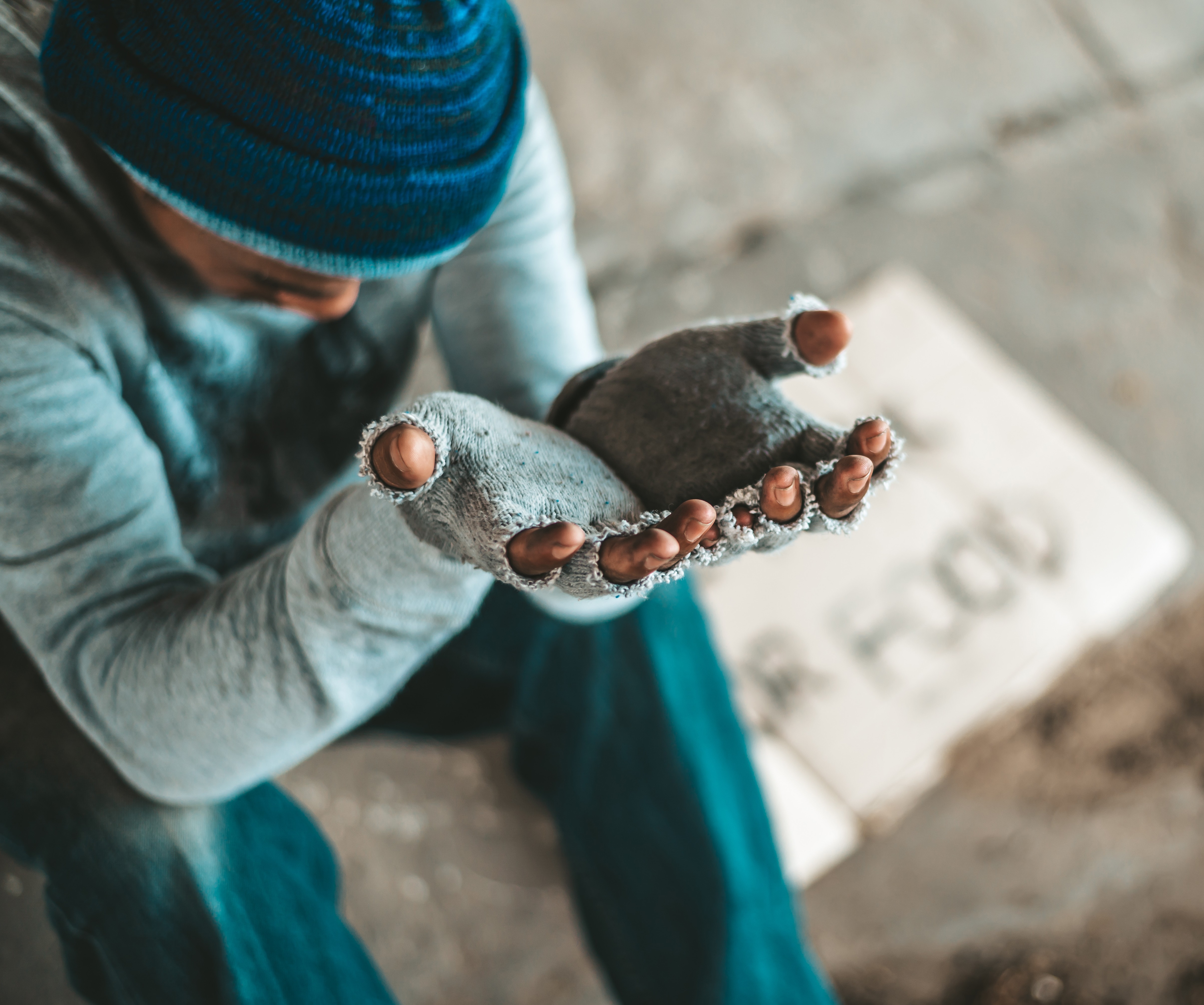
It’s hard to see the “least of these.” Harder to watch. Yet, when I can, it stirs a place in my soul, as it did just recently. I’d taken an elderly friend who’d developed a 103.6 fever to our local hospital emergency room. Now, I’m no stranger to the ER. I’ve spent my share of time there.
But on this night, if you could roll all my former visits into one you still couldn’t match the acute level of suffering and despair I witnessed. My friend and I took the last two seats. Many more patients waited in the hallway, some sitting on the floor. I couldn’t see all of them but one I could see was making herself known.
“You f…’in bastard! I hate you!” she screamed at each person as they walked by, flailing her arms and thrashing her whole body as she lunged forward in her wheelchair. She was young, maybe early twenties and looked disheveled, unkept. A security guard at the exit door stood stoic. Several people with her kept making random, feeble, attempts to quiet the noise. Finally, they took turns resting, leaning their heads against the wall.
In the waiting room, a young man moved from one distorted position to another on the floor. He seemed unable to find a good spot where he wasn’t in pain. And before we knew it, he rushed to get a barf bag and was in the corner violently throwing up. His screeching, gaging sounds, let loose all over the ER. One of the nurses gave him a light blanket and, for a little while, he was still and quiet on the floor. Then, he’d start to move again and throw up. This cycle repeated itself a number of times during the hours we waited.
And then there was Jonathan, as the ER staff called him, not his real name. It was his third visit there that day. Jonathan talked to himself a lot. He was confused and incoherent. His clothes were beyond dirty. At one point, he needed to go to the bathroom and kept yelling, slurring, “Bathroom!” He couldn’t figure out how to get his wheelchair to move toward the door. When it seemed no one was available to help, I pushed him out into the hallway and asked the security guard if there was someone who could take him to the bathroom. The guard responded, offhandedly, that he’d do it.
After over five hours, my friend did finally get seen. As we were leaving, I thought about the group of nurses there during the night. They were scrambling, working so hard to keep up with it all, an exhausting range of physical, emotional and mental health crises, the toll of human suffering, particularly poignant and piercing on this night, the screams, desperation, the smells.
At one point, close to midnight with the waiting room still full, one of the nurses came out and said, “Please have patience folks. We’re doing the best we can. We’ll get to you as soon as we possibly can.” She was hunched slightly forward and had a soft apologetic gaze. She looked to be carrying all of us and time was running out on her endurance.
The next day, as I read again about how Trump’s “big beautiful bill” could cause ten million people to lose their health insurance, I thought about how much more crowded our ERs are about to get. In particular, more patients like the woman in the hallway, the young man on the floor, and Jonathan.
I’d recommend, before voting on any legislation that would disproportionately impact the most vulnerable, lawmakers should be required to spend time in some of the places where “the least of these,” can be found: the local food pantries, shelters, and ERs. Hear their screams, smell their vomit, push their wheelchairs. As it’s reported that over half of our legislators are millionaires, it’s probably been a while, if ever, since they’ve found themselves in such places.
And given that many who voted for the “big beautiful bill” would profess to be Christian, I could only hope that in visiting such places, some might also get stirred and remember, with a sober and humble heart, that key teaching of Jesus. Because unlike the biblical teaching where the least among us are served, the “big beautiful bill” hurts “the least of these.” Sobering, indeed.
But, just perhaps, if the soul were moved, I’d hope they’d renounce their current actions and, instead, follow Jesus’ teaching and do what I believe he would do. They’d make sure the young woman in the hallway got caring mental health services, the young man a supportive detox unit, and Jonathan appropriate treatment and medications and, maybe, perhaps most special of all, a clean set of clothes.
For after all, “What will it profit a man to gain the whole world and lose his own soul?” Matt. 16:26
“Give me your tired, your poor, Your huddled masses yearning to breathe free, The wretched refuse of your teeming shore. Send these, the homeless, tempest-tost to me, I lift my lamp beside the golden door!”
The images flickered. Faces. Smiling. Flashing across the screen and then gone too soon. The children just arriving on Ellis Island, a part of the Ken Burns’ PBS documentary, the Statue of Liberty. I wanted to replay the images, pause them. Take them in. “THIS is what we once were,” I whispered silently.
No more. When I saw the mural of the Statue of Liberty created by Judith de Leeuw and revealed in France just before the 4th of July, I fully understood. Our great lady ashamed, covering her face, grieves her loss.
And so, she should. How starkly different those faces were just a few years ago after crossing our southern border. In Trump’s America, we showed zero-tolerance. Instead of laughter, cries pierced the stale air, raw and shrill, from the shock of being taken from loved ones and put in makeshift cages. Children. In cages. Roughly 4,600 of them separated.
The Biden administration instituted a task force to reunite the children with their parents or relatives but Trump rescinded it, even with hundreds still searching, as part of his first executive order. Today, the policy continues. In June of this year, CNN reported that approximately 500 migrant children had already been taken from their homes and put in government custody. The cries resume now though largely hushed from the public ear.
And our grieving great lady reminds us, “This is NOT who we once were.”
Designed by Frederic Auguste Barthold, the statue was a gift from France to commemorate the centennial of the American Declaration of Independence and dedicated by President Grover Cleveland on October 28, 1886. However, it may surprise some to learn that the well-known words on the statue welcoming immigrants, taken from “The New Colossus” by Emma Lazarus, were not added until 1903, nearly two decades after the statue was unveiled.
The original inspiration for the monument was not immigration but emancipation, notably symbolized by the broken shackle and chains laying at our lady’s feet. Just after the Civil War, they were a visual representation of the end of slavery in the United States. Of course, this ideal has been slow to find a living space where our African American brothers and sisters may breathe free.
Courageously, in the words of the late Congressman John Lewis, the “good trouble” continues for the tempest-tost in search of a home in this land where each “will not be judged by the color of their skin but by the content of their character.” The broken shackle and chains echo across time the great dream herald by the late Dr. Martin Luther King, Jr.
But in Trump’s America, these echoes are fading, almost silent now, in what can only be called a targeted attempt to white-wash history. Juneteenth Day was snubbed. Federal agencies continue to eliminate or obscure the contributions of Black heroes such as the Tuskegee Airman and Harriet Tubman. Diversity, equity, inclusion are dirty words now needing to be eradicated in order to create a more perfect, colorblind, union. Trump even had the bronze bust of Dr. Martin Luther King, Jr. removed from the Oval Office which had been there since 2009.
And again, our grieving great lady reminds us, “This is NOT what we once aspired to be.”
And the broken shackle and chains, which have come to speak for all forms of oppression, also represented the hope of women who, at the time, were fighting for the right to vote. Only two women were invited to the unveiling of the statue which sparked protests by suffragists. American abolitionist Matilda Joslyn Gage, cursing the irony of a female figure representing liberty, described the whole affair as “the sarcasm of the 19th century.”
But, undaunted, the suffragists chartered a boat to sail around the harbor to protest. And our lady must have smiled as she knew that soon, on the teeming shore, she would become the focal point for discussions on gender equality.
Today in Trump’s America, many older women, in particular, are desperately trying to lift the lamp and shine a light on what is quickly being lost – some of the very freedoms those suffragists, and many others since, so courageously fought to obtain for us. Their efforts left all women with the greatest of gifts: most notably, choice. Choice to live a life of our choosing.
And so, we see it’s no accident that the Statue of Liberty is a woman, a depiction of Libertas, the Roman goddess of freedom, offering her torch to guide all who flee oppression.
Americans, will we choose freedom or Trump’s American autocracy? Will we help our great lady to lift her torch high once again and light the way for all of us and for those to come?
I pray so for in all her glory, welcoming those children of long ago, our great lady reminds us, “THIS is what we once were.”
For those of you blessed to attend our Lights On! Applying the Golden Rule to Bridge Religious and Political Divides event this past Sunday, you got to witness first-hand how it is possible for us to join with those with whom we don’t share common religious beliefs or practices and still enjoy one another as fellow children of God. To me, this was the big take-away and gift for us all. Focusing not on religious difference but, rather, on our common humanity seemed key to creating an environment of peace and joy.
We, in the Interfaith tradition, however, do take this a step further. We don’t just recognize our common humanity with all our brothers and sisters, regardless of religious beliefs, we also embrace what we believe is our common divinity. Or like we enjoy saying at the Tree of Life Interfaith Temple, Many are the Ways We Pray to One God. Thinking about this took me back to an important time when I needed to stand and claim this clearly. Here is the story . . .
I still couldn’t believe I was sitting there in that classroom at Andover Newton Theological School in 2014, officially starting my doctoral program. At sixty-four, my mind was whispering, “What are you doing?” And if you’ve read my memoir, Dancing on the Moon: The Non-Ordinary Life I Never Saw Coming, a Spiritual Memoir, you’d know why I was filled with such acute anxiety about the road ahead.
But, as with so many times, it was abundantly clear that this was exactly where I needed to be as it certainly seemed as if divine providence had cleared the way. And, as had always been the case, I could never have imagined what was coming.
There had been fewer than ten of us accepted so I got to know my classmates fairly well right from the start. We were a very diverse group, coming from various ethnic backgrounds, different parts of the country, and one coming from Africa. The common denominator was all of us were either ministers or had extensive experience in a related ministry field, and all of us came from being steeped solely in the Christian faith tradition, all, that is, except me.
Toward the end of the first day, our professor, Dr. Sarah Drummond, Academic Dean, who would become the most influential person in my academic journey, announced that we’d each be required to lead a morning devotional. When she asked who would like to go first, I saw my hand, as if it had some kind of foreign life all its own, slowly rise. “Great, Stephanie. You can lead us in the morning.” Morning?!!
Walking back to my dorm room, the “What are you doing?” became louder but this time took on expanded meaning realizing I was the only student not steeped solely in the Christian tradition. I called my husband, Doug, and said, “Well, I guess it’s time to find out if I really do belong here.” All I kept hearing was that great wisdom from the Bhagavad Gita, Sloka 18:47: “It is better to do your own dharma [divine purpose] imperfectly than to do another’s perfectly.” I knew deeply that I needed to do “me.”
After dinner, I sat down and within half an hour had written The One Called by Many Names. Yes, I would go in full bore. No holding back. I’d offer a devotional that expressed my full heart. If it didn’t fly, well, perhaps this was just an initial step toward some other outcome God had in mind. I’d long learned not to question such things, or to just assume a particular outcome, as my non-ordinary life had repeatedly shown me the folly of that.
The next morning, I first led a centering and then went into The One Called by Many Names, and ended with a short period of silence. Dr. Drummond was slow to open her eyes. When she did, she said quietly, “I didn’t want that to end.” After I explained to my classmates that the A’bwoon D’Bashmaya was the opening of the Lord’s Prayer, Our Father which art in heaven, in Aramaic, a minister from down south chimed in, “I didn’t understand a word you said but we need some of that. I’d like you to come to my church and teach us the Lord’s Prayer in Aramaic.”
And so, I realized that God had, indeed, placed me exactly where I needed to be.
Here is The One Called by Many Names and I’ve also included an audio for your enjoyment. The music behind the audio is “The Gift of Love,” which was played by our flutist in between speakers at Lights On! I couldn’t find one on flute as lovely as our flutist played so I settled on this lovely piano from Hymn Lullabies by O Waly Waly. https://youtu.be/WRITiaF0mH8?si=YzRMgANSrYexeBBm
The One Called by Many Names
I am the One called by many names. Be Still. Listen. I am as close as your breath and as dear as your heartbeat.
Be Still. Listen. You will hear Me on the wind, echoing through all faith traditions.
In Hinduism… You will hear Me in the great OM for, here, all My sounds reside.
In Buddhism… You will hear Me in OM MANI PADMI HUNG for I am the jewel in the heart of the lotus. It is because of Me you blossom, not in spite of, but because of.
In Judaism… You will hear Me in SHEMA YISRAEL ADONAI ELOHEINU ADONAI EHAD for I AM the Lord Thy God and we are One.
In Sikhism… You will hear Me in EK ONG KAR SAT NAM SIRI WAHE GURU for I am the True Wisdom bringing you from darkness to light.
In Islam & Sufism… You will hear Me in LA IL LA HA IL LA ALLAH for when you know Me, you know there is nothing but God.
In Christianity… You will hear Me in A’BWOON D’BWASHMAYA for I am the Formless One bringing form to all creation.
I am the One called by many names. Be Still. Listen. I am as close as your breath and as dear as your heartbeat.
Be Still. Listen. You will hear Me on the wind, echoing through all faith traditions.
Did you know that something quite extraordinary happens every April? I can tell you I’m absolute certain it’s not what you’d expect! I first discovered this awe–filled event many years ago in a poem by e e cummings: when faces called flowers float out of the ground. . .
when faces called flowers float out of the ground and breathing is wishing and wishing is having— but keeping is downward and doubting and never —it’s april (yes,april;my darling) it’s spring! yes the pretty birds frolic as spry as can fly yes the little fish gambol as glad as can be (yes the mountains are dancing together)
I just knew one day I’d get to go to New Hampshire and visit Joy Farm, e.e. cummings’s summer home, because I just knew it was there, he’d found those mountains dancing! And, sure enough, in the mid–1980s, fate brought us here and soon after, in April (of course), we made our way up to Madison in search of Joy Farm and those dancing mountains.
It was a weekend and, being April, lots of snow was still on the ground. We managed to find the entrance to the long driveway up to Joy Farm, but it was fenced off and clearly not passable by car. Undaunted, me, already in full swing with those dancing mountains, was not so easily dissuaded! So, we made our way back to town in search of someone who might be able to give us some kind of permission to venture up to the farm by foot. Doug, my husband, whose feet were a little closer to the ground, well, actually on the ground, kept reminding me that those mountains would not be dancing, so unabashedly, with me in jail!
Luckily, we were able to locate a man with some authority, in one of the local establishments, who gave us the okay. I remember he looked quite puzzled when I, especially, could not be persuaded to return in a couple of months when the road to Joy Farm would be passable. Didn’t he know those mountains were dancing now?!
So, at last, up the long driveway we went! The house had been vacant for a while yet still felt to be alive, standing, waiting patiently for the return of bare feet, frivolous chatter, the smell of barbeque and stargazing off the porch. The grounds were open and rambling and a small gazebo–like room, in the middle of the back field, seemed timeless.
But, without a doubt, it was those dancing mountains, cradling, holding us, that kept me frolicking round and round as if I could somehow fly right into the center of their waking, unguarded alive;we’re alive,dear:it’s (kiss me now) spring! pulse.
Away with respectable composure! Down with petty self-consciousness! Let’s dive as all the pretty birds dive to the heart of the sky and climb as all the little fish climb through the mind of the sea!
It’s April! We’re sun-drenched alive! Our faces like flowers float out of the ground! We’re opening as every leaf opens without any sound! We’re quivering, waking, pulsing as the little fish quiver so you and so i…
So, yes! Let’s dance, unbridled and undone, for its april (yes,april;my darling) it’s spring! and, most wondrously…
all the mountains are dancing; are dancing
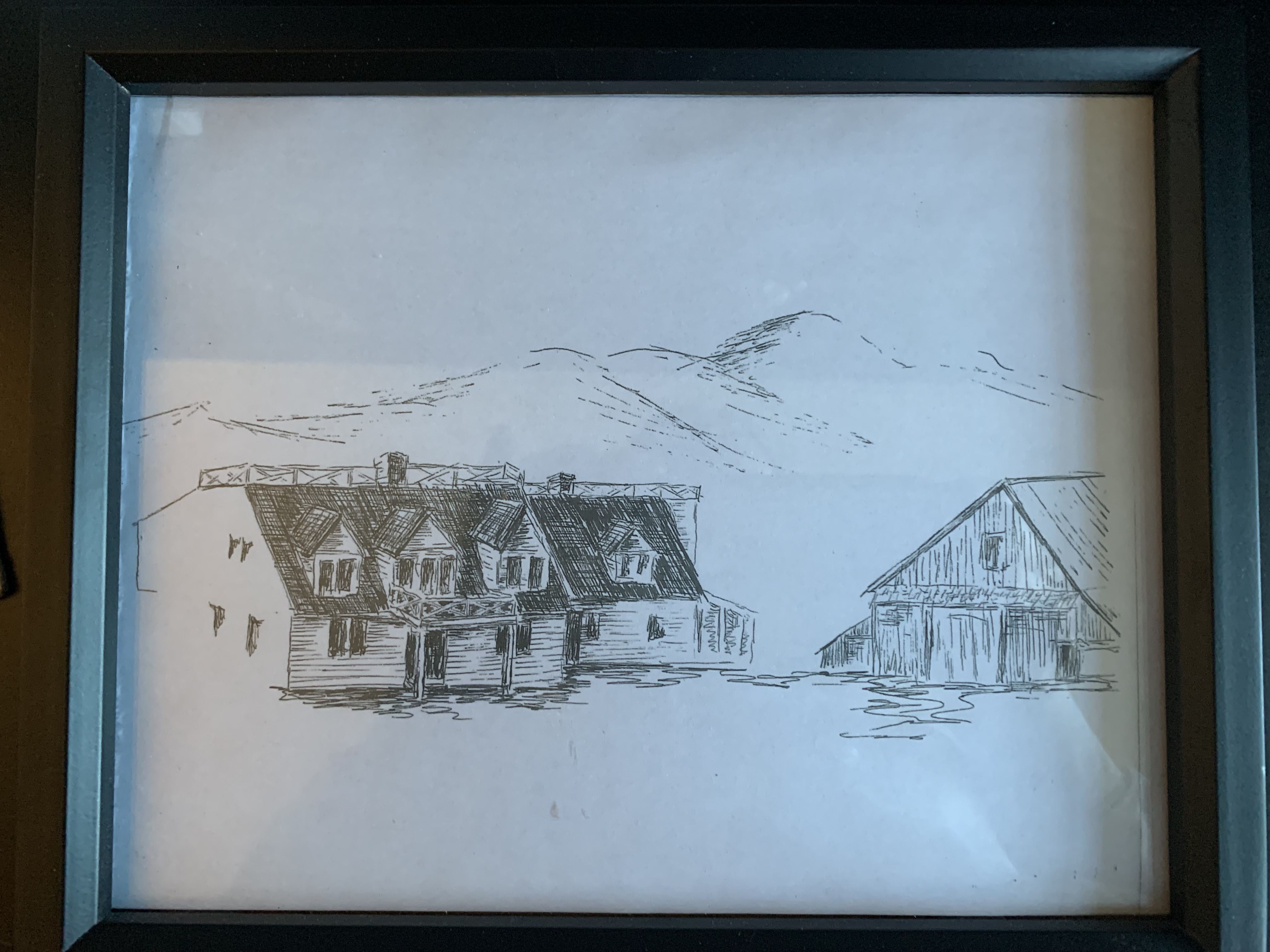
A pen and ink drawing of Joy Farm by my husband as it looked at the time.
And my poem I wrote this year:
I heard You whispering my name though those stars bouncing off the stagnant pond. I felt You in the driftwood sleeping in my hand. I saw You lift that hawk into wispy clouds as the stone people sang in silence.
You are waking and so am I. It’s Spring and I am a fledging eager to fly wobbly and awkward onto a new dream.
It’s April and my heart turns to sunflowers where I see You winking and flirting with my heart. Yes, You are my Love.
And the Song of my Soul erupts through my feet suspending me on Your windy breath in that place where only wonder resides.
Ecstatic now. I can only dance. Wild and free.
The hawk just before being lifted up . . .
Just the beginning of a new nature creation . . . parts that agree to come together to create something beautiful . . .
“I was saved by God to make America great again.” President Trump 2025 Address to a Joint Session of Congress
Many in his MAGA base also believe that. Some Evangelical Christians even exalt him as a prophetic figure, divinely appointed to be here at this time to save the lost. However, I, as a woman of faith, have difficulty reconciling that prophetic belief with President Trump’s actions over the years. In fact, I would argue that most are clearly antithetical to the Christian life.
Can we imagine one who truly follows Christ mocking the disabled, the one who stutters? Can we imagine such a person describing the violence and destruction, the threats to hang Vice President Mike Pence on January 6th as a “day of love,” and then to call the perpetrators the true victims and pardon them? Can we imagine such a person showering accolades on Putin, one of the world’s most notorious dictators, while publicly chastising Zelenskyy, a courageous leader desperately trying to defend his country from an unprovoked takeover?
Meanwhile, as Elon Musk parades like a rock star with his chainsaw, tens of thousands of federal workers are being sent home with little notice, some wondering how they’re going to pay the rent or mortgage next month, put food on the table or how to tell their children their favorite activities have to stop—all challenges the world’s richest oligarchs couldn’t possibly imagine. And who knows what the inevitable fallout of services will be to many of us who rely on them daily. Could we imagine one who follows Christ casually dismissing and justifying all such collateral damage as simply a small price to pay for cleaning up the nation’s waste and fraud?
But, in my view, perhaps the most egregious anti-Christ-like example was conveniently made silent and invisible by the stroke of an executive order on day-one, the “Executive Order Protecting the American People Against Invasion.” Among an array of former immigration policies Trump rescinded in conjunction with this Order was Biden’s Executive Order 14011 that had established a task force to reunite families separated by Trump’s “Zero Tolerance” immigration policy.
On Dec. 19, 2024, The Latin Times cited a joint 135-page report by Human Rights Watch, the Texas Civil Rights Project (TCRP), and Yale Law School’s Lowenstein International Human Rights Clinic highlighting the over 4,600 children who were deliberately separated from their parents between 2017 and 2021 and the lasting harm incurred as a result.
The report states that children were held in overcrowded conditions and often lacked adequate food, hygiene supplies, and supervision. Guards often ignored crying children or subjected them to verbal abuse. No doubt, as many health professionals warned, such separations could cause severe, lifelong psychological harm.
Today, as many as 1,360 children still remain separated from their parents. Think about that. 1,360 children who may never know where, or perhaps even who, their parents are.
Images of the separations, the children, are well documented. I often think about the very young ones, those just old enough to feel it all but not yet old enough to know what’s happening or to understand. If you are strong of heart, take a look. See their faces. We did this.
“Let the little children come to me and do not hinder them, for the kingdom of God belongs to such as these.” Matt. 19:14
No one argues that we need immigration reform. No one disputes that we need to target the most violent criminals attempting to cross into our country and that we need to stem the flow of fentanyl and other dangerous drugs. No one. But to have perpetrated such violence on innocent children and their parents, many of whom came here to escape horrendous conditions, is not only far from Christ-like, it’s indisputably inhumane and cruel.
But on day-one, President Trump took it a step further. He doubled down on the cruelty to ensure that those remaining 1,360 children would no longer have any governmental support to find their parents.
There’s a clear and present danger here. Perpetrators, domestic and foreign, are praised. Victims are ignored or blamed. Unloading our national debt has been transferred onto the backs of tens of thousands of everyday Americans, while the oligarchy running our country celebrates numbers on the national spreadsheet. And gangs haven’t paid the price at the border. Children and families have.
If Trump was sent to save America, I would say it is we who are now living in the land of the lost. But I still believe, as John Newton wrote in the well-known hymn, Amazing Grace, that with just a little true Christ-like care for one another, we too as a nation may one day be able to say, “I once was lost, but now I’m found; was blind but now I see.”
It was like we were there that afternoon of January 6, 2021 as we watched in disbelief the violence erupting at our nation’s Capital. We kept checking across various news outlets from MSNBC to Fox News to make sure what we were seeing was really happening. And, sadly, we were confronted again and again by the same violent images. In the days that followed, many lawmakers on both sides of the aisle would forcibly, and rightfully, condemn the violence.
But soon the tide was recalibrated as allegiance to our flag and Republic went silent, drowned out by the growing vocal allegiance to Trump instead. Memories began to morph as Republican lawmakers tried to convince us that, essentially, we hadn’t really seen what we’d seen. Desperate to remain in good stead, strengthen the alliance, and court favor with their emerging autocratic leader, spines went soft. Most troubling, the ability to stand for the true heroes of the day, the Capitol Police officers, waned.
And today this morphing has culminated in a full reversal of the facts of what actually happened on January 6th. Now we’re told not only did we not see what we saw but, in reality, just the opposite happened. By continuing to describe the insurrectionists as “hostages,” Trump and his top guard have been reprogramming us to see what they want us to see: the violent mob that attacked the Capitol that day were simply true, unarmed, patriots.
This, of course, was predictable and unsurprising. After all, the so-called hostages had done their due diligence by showing clear and proper allegiance to Trump before they tried to destroy all constitutional vestiges of power. And we, having been duly programmed, were now primed to at least consider that it was really the rioters who were the true victims of that day. In this way, Trump could pardon them all with minimum fear of political backlash.
“I pledge allegiance to President Trump, and to the Republic which he has formed . . .”
It just may have worked—“if” we hadn’t seen with our own eyes what we saw. But we did. We did, in fact, see many of the rioters come armed with a variety of weapons such as stun guns, pepper spray, baseball bats and flagpoles wielded as clubs. We saw the violent attacks on police officers just doing their sworn duty that day. 140+ of them were injured, some seriously. Others would die in the days and weeks following including Officer Brian Sicknick, 42, an Iraq War veteran, who died the next day from wounds caused by a fire extinguisher to the head. We saw the lynching noose and heard the cries, “Hang Mike Pence.” And we watched, horrified, as the Confederate Flag was proudly carried through the Capitol.
Those of us who witnessed the events of January 6th must now not remain silent, lest we appear to be following along like imprinting ducklings to Trump’s self-serving propaganda. We must stand with the National Association of Police Officers and the International Association of Chiefs of Police, along with many US citizens, Republican and Democrat, who’ve condemned Trump’s decision to pardon those involved in the insurrection.
We must not cower and avoid dialogue as Trump’s top guard is doing. This should show us all that they’re unwilling to engage in any discussion that may potentially displease or threaten their leader. They’re clearly fearful and rightly should be. After all, autocrats get even particularly when they believe they’ve been touched by the providential hand of God and now have a Supreme Court willing to shelter and protect all actions done under the cloak of the office.
“I pledge allegiance to President Trump, and to the Republic which he has formed, one nation duly governed by him, God’s chosen servant . . .”
Sadly, Trump told us who he was in 2016 when he said, “I could stand in the middle of 5th Ave. and shoot somebody and I wouldn’t lose any voters.” At the time, most of us dismissed it as simply a grossly inappropriate display of chest-thumping. Today, we know it’s absolutely true. Trump could stand out in front of the Capitol building, kill someone while many watched, and by the evening news the channels supporting Trump would be assuring us that we really hadn’t seen what we’d seen—that what we’d really witnessed was, in fact, a most courageous and patriotic act carried out by our illustrious, divinely appointed, leader.
And, we’d all be encouraged to pray for him, placing our hands over our hearts as we remembered our Pledge of Allegiance:
“We pledge allegiance to President Trump, and to the Republic which he has formed, one nation duly governed by him, God’s chosen servant, to offer liberty and justice as decreed.”
To all who treasure democracy, let’s not falter at this critical moment! Let’s fight for the country our forefathers dared to envision, now on life support, so, just maybe, our children and grandchildren might one day still be able to stand and pledge allegiance to the flag and to our great Republic for which it stands.
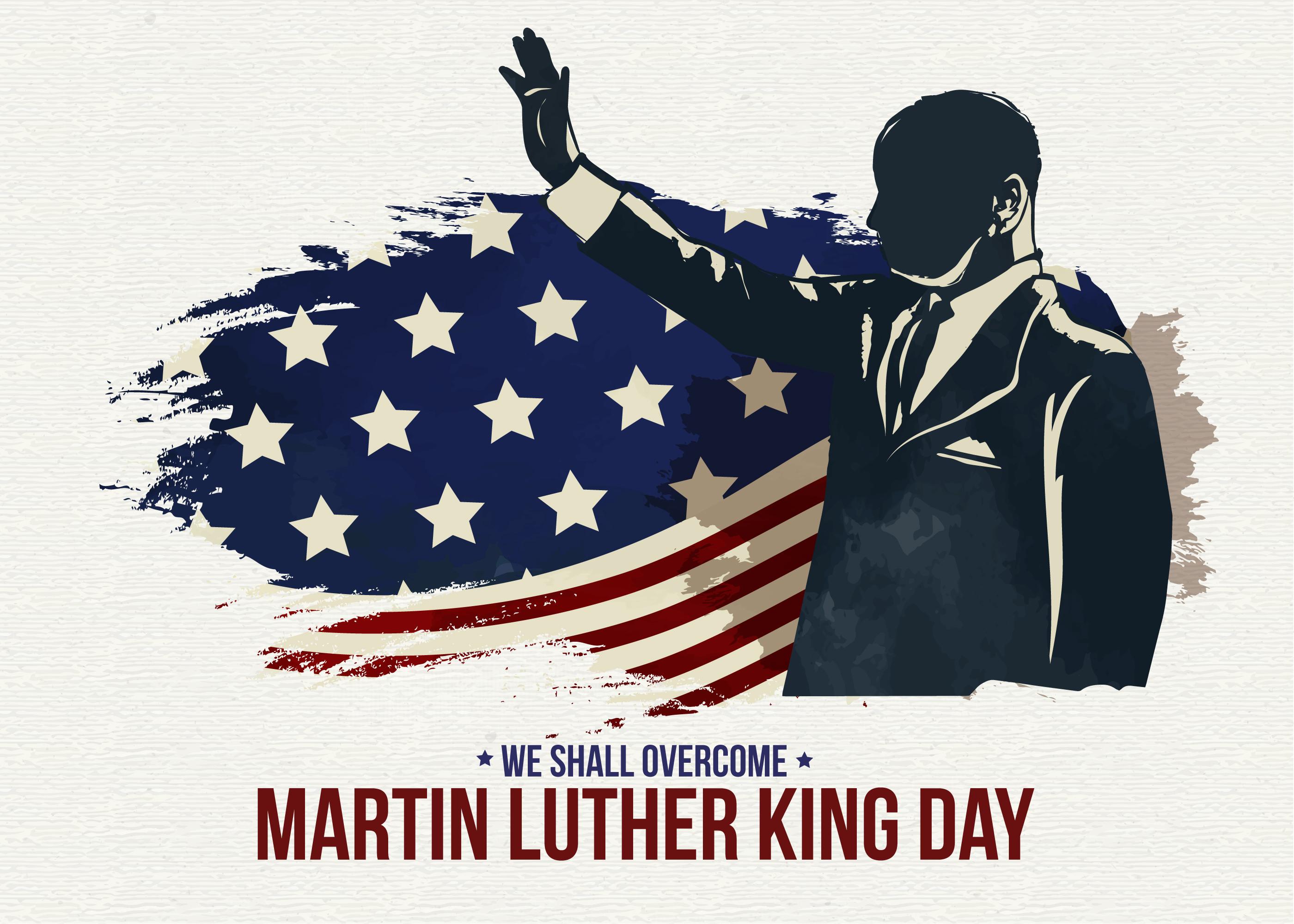
In honor of Dr. Martin Luther King, Jr. day . . . A blog I first posted in January 2020.
In 2016, I visited the largest mosque in New England, The Islamic Society of Boston Cultural Center (ISBCC), in Roxbury Crossing, MA, to hear Sheikh Yasir Fahmy speak on The Toxicity of Othering. As usual, I did not receive what I expected. No, I received so much more!
About a third of the way through, I started to recognize similar teachings to that of Dr. Martin Luther King, Jr. I noticed that if I were to remove the Arabic phrases the Sheikh occasionally included and changed “Allah” to “God,” that, indeed, the core message would seem to be the same. Curious, once home, I listened to the video again off the ISBCC website and printed out a transcript. From there, my journey began and below are my findings which led to the creation of The Sheikh & The Preacher. The essay, expanded from this blog, was chosen for inclusion in the anthology One Nation, Indivisible: Seeking Liberty and Justice from the Pulpit to the Streets, edited by my former professor Celene Ibrahim and released by Wipf and Stock Publishers in 2019.
The four key categories below came to me as I heard the similarities unfold. The sub-headings I also included as a way to highlight the specific teachings within each category. Sheikh Yasir Fahmy’s quotes have been occasionally edited by punctuation only to facilitate ease of reading. The numbers noted at the end of each quote indicate where in the video the wording appeared. The quotes by Dr. Martin Luther King, Jr. are taken directly from the sources indicated at the end of each quote.
Enjoy…
Origins of Unhealthy Otherness
Exalting the Self and the Self’s Group as Superior
The Sheikh:
“We want upliftment. We want recognition. We want stability. We want to be known and recognized. We want to be justified. Because of our distance from Allah, we think that the only way I am to make myself big is by belittling others.” (25:05 – 25:34)
The Preacher:
“We all have the drum major instinct. We all want to be important, to surpass others, to achieve distinction, to lead the parade…And the great issue of life is to harness the drum major instinct. It is a good instinct if you don’t distort it and pervert it.” (Sermon at Ebenezer Baptist Church, February 2, 1968)
Outcomes of Unhealthy Otherness
Removing the Inferior Others
The Sheikh:
“[At the extreme, this need for recognition] becomes toxic, demonic, destructive. The self becomes self-aggrandizing and self-absorbed. (2:57 – 3:11) You are a danger to my existence, to my power. You threaten me so I want to destroy you. (5:35 -5:43) [These are] diseases of the heart that exist at the root of this toxic other. (18:44-18:50)People have trouble distinguishing between religious or cultural expressions and human value.” (9:48 – 9:54)
The Preacher:
“We’ve been in the mountain of war. We’ve been in the mountain of violence. We’ve been in the mountain of hatred long enough. It is necessary to move on now, but only by moving out of this mountain can we move to the promised land of justice and brotherhood and the Kingdom of God.” (Sermon at Temple Israel, February 26, 1965)
How to Combat Unhealthy Otherness
Humbly Examine the Self
The Sheikh:
“So, brothers and sisters as we think critically about this disease that exists in our society we have to begin with ourselves. We begin by looking in the mirror and thinking, ’Am I a person who otherizes?’ Am I someone who puts others into other ugly categories and belittles them because of who they are?” (21:49 – 22:13)
“We must take a step back and before really thinking about what people are doing to me, I have to ask myself, ‘To what extent do some of these diseases exist within me?’ For to them as you do it, it will be done to you. Before we sit there and look at others, we have to ask, ‘Am I truly embodying the best of prophetic ideals in this particular regard?’” (7:10 – 8:02)
The Preacher:
“Now first let us deal with this question, which is a practical one: How do we go about loving our enemies? I think the first thing is this: In order to love your enemies, you must begin by analyzing self. And I’m sure that seems strange to you, that I start out telling you this morning that you love your enemies by beginning with a look at self.” [later] “There might be something within you that arouses the tragic hate response in the other individual. And this is one of the tragedies of human nature. So, we begin to love our enemies and love those persons that hate us, whether in collective life or individual life, by looking at ourselves.” (Loving Your Enemies, Nov. 17, 1957)
How to Cultivate Healthy Otherness
The Sheikh:
The purpose of all creation is ‘so you may know one another,’ to have an intimate engagement with people. [Allah said] I made you into these different tribes that you might know one another. So, it is through humility—that is the way we begin to heal the pains of our society.” (29:36 – 29:56)
The Preacher:
“People fail to get along because they fear each other; they fear each other because they don’t know each other; they don’t know each other because they have not communicated with each other.” (Advice for Living, May, 1958)
Recognize the Common Unity and Destiny of the Human Soul
The Sheikh:
“When Muhammad stood up before a Jewish funeral procession and was asked why, he replied, ‘Is he not a soul that deserves honor, dignity and respect? He is a human soul and, therefore, has inherent value and has inherent sacredness and sanctity and the human soul should be honored and respected regardless of the realities of that person. That’s the prophetic ideal that must thrive in societies.’” (8:15 – 8:59)
The Preacher:
“They [our white brothers] have come to realize that their freedom is inextricably bound to our freedom. We cannot walk alone. [later] We will be able to speed up that day when all God’s children, black men and white men, Jews and Gentiles, Protestants and Catholics, will be able to join hands and sing in the words of the old Negro spiritual free at last! Thank God Almighty, we are free at last!” (I Have a Dream Speech, August 28, 1963)
See the Sanctity Within Each Person
The Sheikh:
“Am I someone who has genuine honor for others, genuine love? Can I see the sanctity in human beings no matter who they are? Rather than looking out into the world, rather than seeing all the ugly, I see all the beautiful. I see the beauty of human beings who are struggling to just be there.” (22:17 – 22:34)
The Preacher:
“I have a dream that my four little children will one day live in a nation where they will not be judged by the color of their skin but by the content of their character.” (I Have a Dream Speech,August 28, 1963)
Seek to Love and Forgive Your Enemies
The Sheikh:
“Only Allah can measure the God consciousness of others. It’s not your responsibility to identify others as being this or that. (27:40 – 28:03) We hold dear to our beliefs. We have a distinct desire to see that human life is treated as sacred regardless of the differences that may exits—even in the quote-unquote enemy. No matter your worst enemy, whoever they may be, they deserve dignity as prescribed by Allah.” (16:22 – 16:58)
The Preacher:
“And so I stand here to say this afternoon to all assembled here, that in spite of the darkness of this hour, we must not despair. We must not become bitter nor must we harbor the desire to retaliate with violence. No, we must not lose faith in our white brothers.” (Eulogy after bombing of Sixteenth Street Baptist Church, September 18, 1963)
Care for One Another
The Sheikh:
“That’s what it means to be a mercy to mankind. To dignify others is to make sure that everyone comes before me. I want people to be lifted high and if it requires that I bow down and that my neck is broken for others, I will do it. That is the prophetic spirit. That is what it means to honor others, to care for others, regardless of religion or ethnicity or race or even in financiers in the economic realm.” (20:16 – 20:50)
The Preacher:
“The true neighbor will risk his position, his prestige, and even his life for the welfare of others. (From his 1963 book, Strength to Love.) Everybody can be great because anybody can serve. You don’t have to have a college degree to serve. You don’t have to make your subject and verb agree to serve. You only need a heart full of grace; a soul generated by love.” (The Major Drum Instinct, sermon adapted from the 1952 homily ”Drum-Major Instincts” by J. Wallace Hamilton, 1952)
Cultivate a Consciousness of Love
The Sheikh:
“The most dignified and the most honorable amongst creation is the one who has the most God consciousness.“ (26:50 – 26:57)
The Preacher:
“Inject within the very structure of the universe that strong and powerful element of love.” (Loving Your Enemies, Nov. 17, 1957)
Seek to be Vehicles of Goodness and Unconditional Love
The Sheikh:
“May he make us vehicles for good on this earth. May he make us prophetic vehicles of change toward goodness on this earth. May we be sources of mercy for others on this earth.” (26:57 -29:28)
The Preacher:
“Man must evolve for all human conflict a method which rejects revenge, aggression and retaliation. The foundation of such a method is love. [later] I believe that unarmed truth and unconditional love will have the final word in reality.”(Noble Peace Prize Acceptance Speech, December 10, 1964)
Closing Quote: The Sheikh
“May Allah rectify the conditions of our humanity on this earth. May he allow it to begin with us. May he guide us, guide through us. May Allah rectify our hearts of the diseases that have caused the problems that we see today so that we can see a society that is prospering.” (30:17 – 30-22)
Closing Quote: The Preacher
“I have a dream that one day every valley shall be exalted, and every hill and mountain shall be made low, the rough places will be made plain, and the crooked places will be made straight; and the glory of the Lord shall be revealed and all flesh shall see it together.” (I Have a Dream Speech,August 28, 1963)
I used to hate Christmas. Well, not “Christmas” really. Just what it’d all come to mean, especially after the kids were grown, and there was no more special magic building up to Christmas morning. What seemed left was a non-negotiable requirement to shop, spend, wrap, mail and oh, by the way, do it all in the spirit of joy, peace and love. “Sure,” I’d think trying hard to hold off the low simmer of resentment brewing just under the surface.
“Whose idea was this anyway?” I would silently complain feeling quite certain “someone” must be responsible for my checkbook going red, pants bulging from overeating and stress stealing me away into that just-get-it-done zone. Certainly, there were moments that seemed to make it all worthwhile. But, still, I would silently celebrate when it had all passed, even as I would try to ignore that ever so subtle sense of sadness. This is “not” what Christmas should be about! Something’s off.
It was. And, it was me.
So, my husband and I launched a concerted effort to make Christmas our own again and, with enthusiastic intentions, encouraged our family to join in our revolution to reclaim the mystery or, at least, our sanity. Along the way, we tried different things. One year we asked that everyone bring a contribution to our Christmas dinner as an expression of our gift to one another. Worked fine until we discovered that enchiladas didn’t go so well with pumpkin soup. Another year we suggested we all give only handmade presents until we remembered that we were the only ones with flexible time, or perhaps even the inclination, to enthusiastically create such gifts complete with all the joyful trimmings.
Then, one Christmas, unexpectedly, something happened, and I found myself totally caught up in that “something.” Maybe it was decorating the tiny jewelry box I was drawn to give my granddaughter miles away with her favorite Bible saying. Yes, quite grandma-looking but what fun I had! Or hunting down the Rudolf the Red-Nosed Reindeer record book for my oldest grandson who has Autism, his favorite Christmas story. Still even more heartwarming would be watching him on Christmas day listen to the recording over and over again. Or when I found just the right frame for that special picture of my two youngest grandkids holding hands walking down a forest path from our mountain cabin. Mission accomplished! Yes! Amazing!
“How ‘could’ this get any more fun?”
But, still, there was more. Suddenly, I couldn’t pass by a Salvation Army jingle without giving, and was a little surprised by that lump in my throat. A not serious, yet unavoidable, trip to the doctor let me know that the visit was only for me in a minor way. I’d really been sent on a secret Santa mission.
“Oh, my God. Thank you! I accept!”
And then being nudged to give something away from my prayer space I’d long cherished. This one gave me pause. “Really? Are you sure?” And then I could only smile. “Of course, ‘You’ are sure! I’m the only one questioning here! Ok. Done!
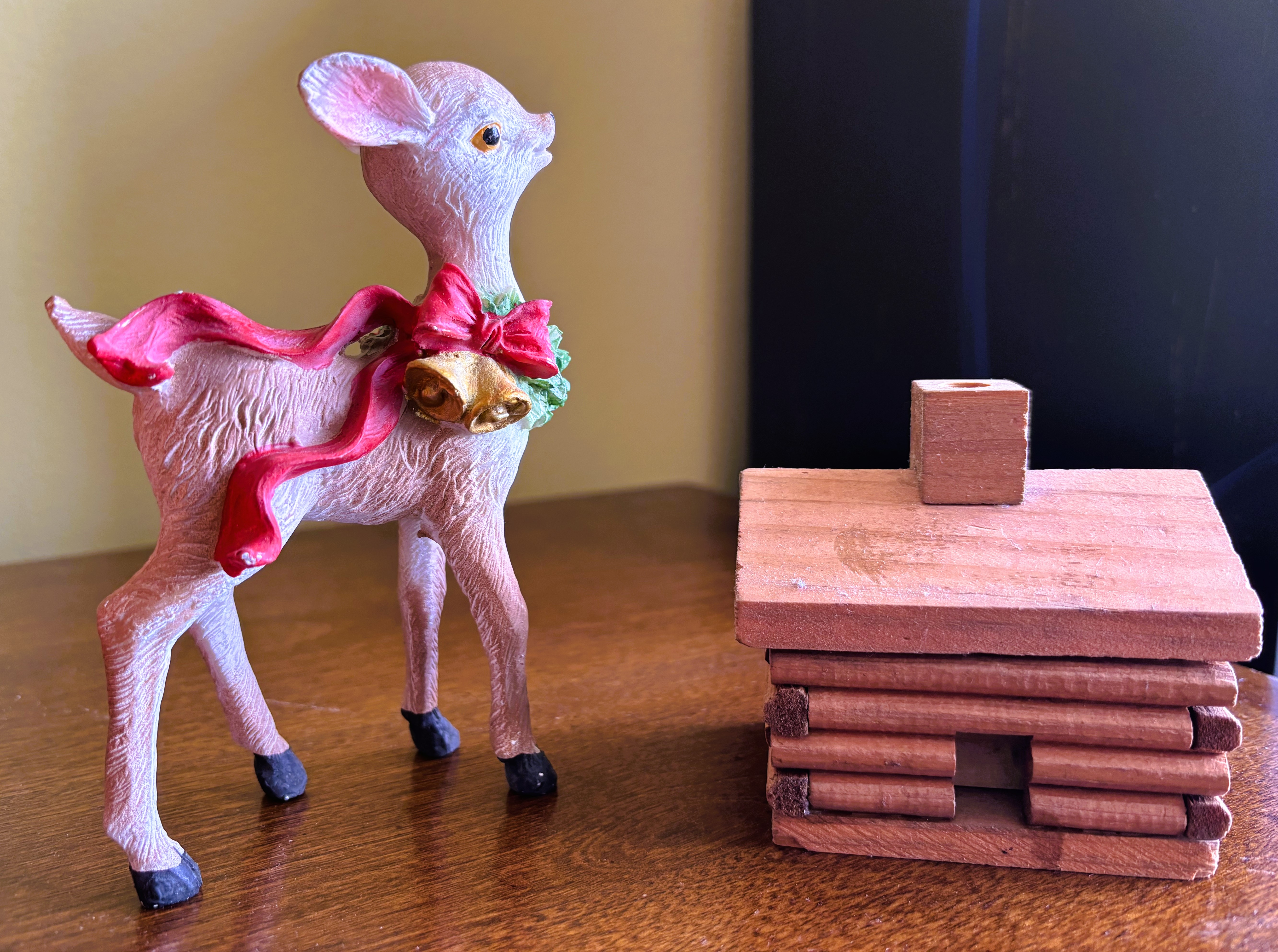
But, perhaps, the most special was finding that last minute gift for my husband, a small wooden cabin incense holder. Oh, I just knew he’d love it. What I didn’t know was that it would instantly bring him back to a sweet memory from his childhood remembering his mom had had one exactly like it. Only the day before, we’d talked of his mom, long passed, over our morning coffee.
“Oh no! Christmas can’t be over! No!” I thought. “There must be a way to make this feeling last all year long. Oh . . . yes, that ‘is’ the point, isn’t it?”
Now, my only concern: “How ‘will’ I deck my hammock out with all those boughs of holly?”
But wait! I’m remembering, “All things ‘are’ possible to him who believes.” (Mark 9:23)
Amen.
Merry Christmas Everyone!
And here is the small cabin today alongside our Christmas deer.
I’ll keep the picture I took yesterday close as a symbol of what democracy can look like at its best. A memory of a great experiment of inclusion, the dream our founding fathers laid out in our Constitution and exemplified by the Statue of Liberty – that it is possible to hold the tensions of diversity within the greater framework of our unity as Americans. But as Benjamin Franklin reminded us, in response to being asked about the type of government being established by the Constitution, “A republic,” he said, “if you can keep it.” Yesterday, election day, I had a glimpse into how it just might be possible to keep it.
I was holding a sign for democrats at my voting location and found myself right next to a group of red signs. “Ummm,” I thought, “time to practice what I preach,” so I introduced myself. Cautiously, they reciprocated. Then, in an extempore moment, I asked, “Would one of you mind taking a picture with me? I think, after all, this is what America is all about.” A brief pause of silence and then a man said, “Sure.” And so, we did.
Throughout the day, conversation went back and forth between us. They shared why they’d supported Trump. I shared why I could not. One woman proudly said she’d been at the Capital on Jan. 6th. I shared what a scary time that had been for me especially seeing all the violence, destruction, the Confederate flag being flown inside, and the hanging noose with shouts of, “Hang Mike Pence!” all as Trump watched. They blamed Nancy Pelosi.
Finally, we were able to agree that we live in very different news bubbles and therefore had largely arrived at different beliefs and narratives about a number of issues. Though we clearly disagreed, the exchanges continued to be amicable. I could also hear the man, with whom I’d taken the picture, talking to a passer byer about his life saying how his job and health had collapsed under Biden. I could sense his deep anger and frustration.
At one point, a couple of young women arrived all dressed out in flag outfits that were, quite honestly, pretty amazing and someone asked me to take a picture of the group. After, I said, “Great outfits!”
“Well, at least you’re cordial,” said one of the women, glancing at me dismissively with an air of distrust. “Most of you just call us trash.” A little later they left in a truck flying huge Trump flags. I thought, “I hope I gave them a glimpse into the ‘you’ they may have thought I was and that, just maybe, they could see not everyone thinks of them as trash.”
By noontime, one of the women in the group asked, “Hey, would you like a chicken wing? We have plenty.” She shared how she often makes food for the meals at her church, and we went on to talk more about our perspective churches and activities.
When it was time to go, I went over to the man with whom I’d taken the picture. I reached out to shake his hand and said, “I enjoyed being with you today. Take good care.” He looked like he didn’t know quite what to do but said quietly, “Thank you.”
I realize the coalition of supporters who ushered in Trump’s return to office is multifaceted. Some, particularly Christain nationalists and proponents of Project 2025, would prefer not to keep our republic but, rather, have us become a theocracy based on their interpretation of scripture. There are those who don’t necessarily even believe democracy is the most efficient form of governance, actually preferring a more autocratic type of leadership. And then I suspect there are many like the man with whom I took the picture who believe it was the current administration’s policies that have caused all their current hardships and struggles.
Still, I, being wholly committed to our great democratic experiment, will continue to practice welcoming all into conversation when the opportunity arises. And it is, indeed, a practice to look beyond religious affiliation, race, ethnicity, gender, sexual orientation, all variations of diversity, in search of the unity which lives in our common humanity – the unity which makes it possible not just to see one another as Americans but also as brothers and sisters.
I realize not everyone is wanting or is able to do this. No matter. That will not change what I do. As Project 2025 begins to be implemented, I will keep a vigilant lookout for all who feel squeezed by imposed governmental regulations and religious ideologies. I will practice welcoming any persons feeling disenfranchised to be seen and heard.
Sometimes the most challenging times offer the greatest opportunities. I like to think this is a time not to fight against, but rather for, the unity that can only be recognized in our common humanity. If we can do this, who knows? We just might be able to keep our great republic after all.
I once asked a bird, ‘How is it that you fly in this gravity of darkness?’ She responded, ‘Love lifts me.’ Hafez
Recently, I was offered the most beautiful gift. Rev. Barbara Landry, Tree of Life Seminary Class of 2011, asked if I’d like to speak about my newly released memoir, Dancing on the Moon: The Non-Ordinary Life I Never Saw Coming, A Spiritual Memoir, on her podcast, “The Truth So Help Me Good.” As I listened to the recording, it occurred to me that for all I’ve written in books, blogs, articles, or spoken in classes, workshops and presentations, this is the first time I’ve talked about the seminal events in my personal story which would shape the trajectory of my life and become inextricably interwoven with my spiritual journey.
While I first mentioned a part of the early events in my July 2018 blog, The Monomyth: The Heroine’s Journey, and again recently in my June 2024 post, A Memoir Journey, I write the full depth of it in the introduction to my memoir, When the Katydid’s Went Silent, and have given it my voice here on Rev. Barbara’s podcast for the first time.
Listing to the recording, it occurred to me how many times I’ve wanted to know the personal story of my spiritual teachers. While so many have gifted me in immeasurable ways, it feels important for those of us offering ourselves as spiritual teachers and guides to also be as transparent as possible, in appropriate ways, with those we serve. To not be so can run the risk of fostering a sense of spiritual superiority or separateness.
I believe we, as spiritual teachers and leaders in the Aquarian Age, are called not to sit apart and above in the old patriarchal paradigm but, rather, with and among. Having walked the spiritual path, we’re able to be transparent, speak authentically, and offer up our own life experience as just one illustration as to how, in the end, the personal and divine journeys are one and the same. And in the telling, we are all lifted from the darkness of separation into the light of connection and unity where we find one another and know ourselves to be, at once, unique and the same.
Rev. Dr. Stephanie Rutt offers her work through the Tree of Life School for Sacred Living, LLC, and also serves as Founding Minister of the Tree of Life Interfaith Temple in Amherst, NH. She is the author of five books and additional interfaith curricula. To learn more about her books, as well as online and in-person classes and workshops, please visit her website at https://www.stephanierutt.com.







 Stephanie Rutt