
Tag Archives: feminism

The Cage Keepers

“My heart is flailing, thumping in my chest like a bird caught in a cage, wanting to be wild again.” Sona Charaipotra

The cage door is open and the cage keepers are busy setting the conditions to slowly, deliberately, lure girls and women back in. If you think this is some anti-woman dystopia, imagined by fringe groups or relegated to a fantastical future, think again. It’s here. Now.

Sadly, it’s happening while most women are busy flying, caring for their families, raising children, getting degrees, building careers, enjoying the freedom to create lives of their choosing. Nowhere on their radar is the possibility that one day, sooner rather than later, their cherished freedoms, the ones they’ve always taken for granted, could no longer exist. That one day, they could wake up to find themselves in a tiny enclosure with the cage door shut, flying only a memory.

Ah, but the lure is so carefully crafted, delectably sweet-coated with biblical authority, that even some women are falling victim, truly convinced that life in the cage must be the best life. And the cage keepers are betting as Marc and Angel Chernoff first warned, “Surely if a bird with healthy wings is locked in a cage long enough, she will doubt her own ability to fly.”   

And who are these cage keepers? They are part of a growing, right-wing, ultraconservative, radically patriarchal movement, embracing Christian Nationalism ideals. Their goal is to roll back all the gains, born of years of struggle, to return women to the cage, most lovingly cared for, of course, by their cage keepers: fathers, husbands, brothers, sons.  

It’s believed this is the only way that God’s true plan for the Christian family and society can be realized. In this family, the husband is the rightful head of household and the wife becomes fully subservient in all matters of both family and society. And perhaps most disturbing, many believe it’s been the singular result of women leaving the cage to fly that has not only caused the breakdown of the family but, by extension, society itself.  

How tidy. Women are the problem the holy men of God, the cage keepers, have been called to redeem in order to save society. While tragically simplistic and void of any critical thinking outside the narrow confines of the adopted biblical view, it is still clearly dystopian for women.

Think I’ve gone too far? Let’s look at just a few examples of how this movement is gaining traction. This month, the Southern Baptist Convention, representing the largest Protestant denomination, will vote once again to strengthen its prohibition on women serving as church leaders and preachers. Pause a moment and think about what this is actually saying. If women are encouraged to hear and discern God’s word directly for themselves, and to share their revelatory understanding and experience, the theological discourse between men and women becomes equal. No longer would it be presumed that men hold special access to the holy simply because they are men. So, it becomes imperative that church leaders convince women to leave biblical interpretation, sermonizing, and proselytizing to them. What’s really at stake here, as well as in many other religious traditions, is the very survival of the patriarchy.          

But it goes beyond houses of worship. A prominent voice in the Christian Nationalism movement is evangelical theologian and pastor, Doug Wilson. He advocates for the merging of church and state and implementing a biblical, patriarchal society. One key aspect is “household voting” whereby each household gets one vote, the husband’s, eliminating the need for the wife to vote. In addition to the 19th Amendment, women have fought long and hard to legalize equal access to education and employment, to own property, earn an independent living, and to run for political office. One can only imagine how long it might be before these freedoms would also be repealed in the wake of losing the right to vote.

And abroad, more signs that we’re descending into an anti-woman dystopia. According to a June 16,2026 story by Zing Tsjeng in The i Paper, in February the US withdrew from the UN Women Executive Board, the United Nations agency for equal rights. A month later, the US voted against a United Nations document that ratified women’s rights. Citing “ambiguous language promoting gender ideology,” the US was the ‘only’ country of forty-six countries to vote, that voted against women’s rights at the UN. What an ominous message, from the leader of the free world, this sends to women around the globe.    

Luckily, you can cage a body but not the human spirit. The spirit, when not doubting its ability, will always choose the open sky, to chart its own course, knowing the winds of grace will guide and sustain.

Indeed, it will always choose to fly, wild and free.
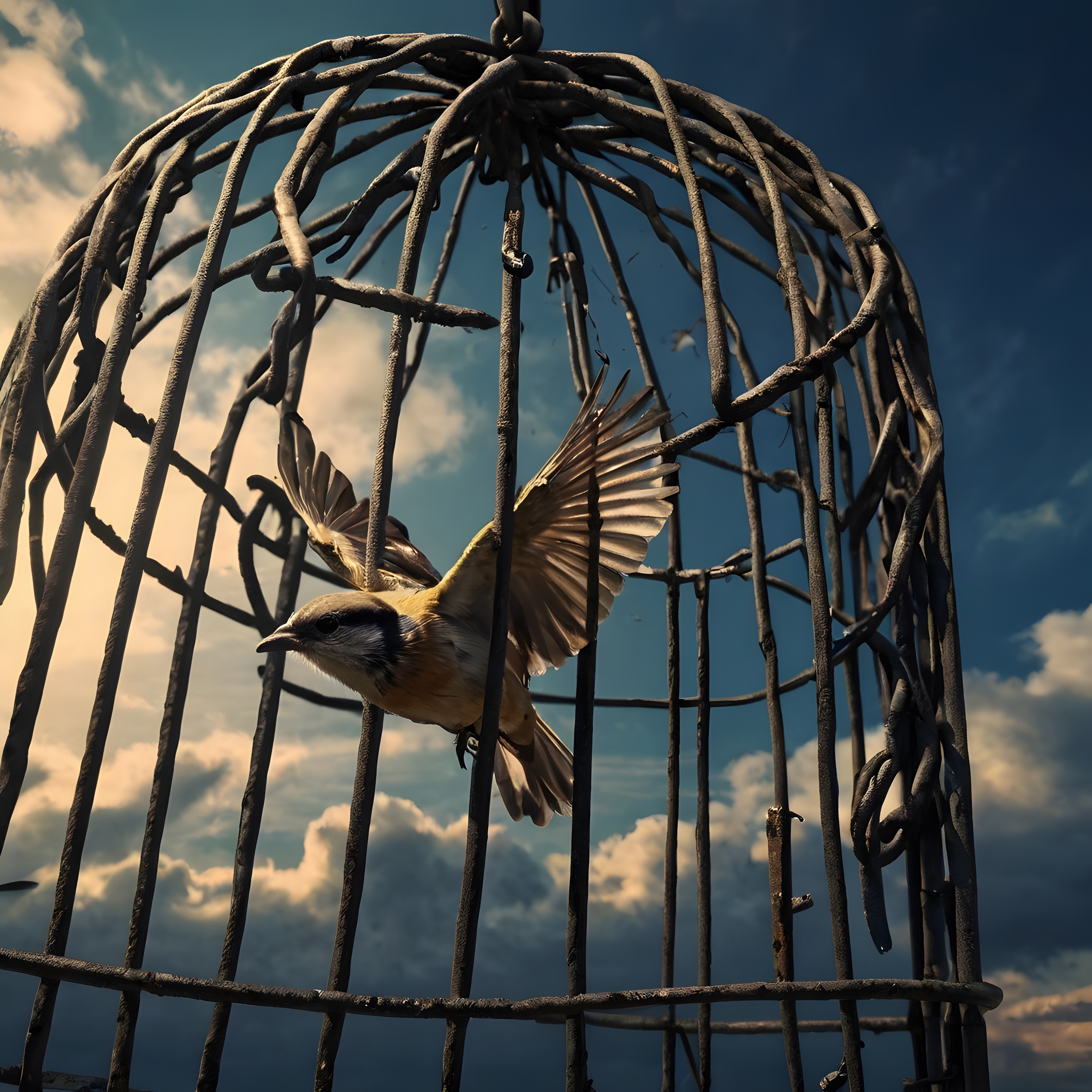
Image by Aeye at freepik.com

4 Comments

Filed under Uncategorized

Everybody’s Girl: For Virginia Giuffre

“But the worst things Epstein and Maxwell did to me weren’t physical, but psychological. From the start they manipulated me into participating in behaviors that ate away at me, eroding my ability to comprehend reality and preventing me from defending myself.” Virginia Giuffre, “Nobody’s Girl.”

It doesn’t happen as a flash headline. It goes unnoticed behind the scenes meticulously woven into the tapestry of society. Hidden, like the lost piece of a puzzle, revealed only to those courageous enough to pause, see, hear. Left unnoticed, it soon fades, silent and lost, and becomes like a footnote you’d look for later to try and understand. It is the voice, song, of our most vulnerable girls and in the notation, the redacted names of rich and powerful men.  

The great irony of the enslavement was, Giuffre writes, “There were no bars on the windows or locks on the doors. I was a prisoner trapped in an invisible cage.” Having worked as a mental health counselor, I know all too well about that invisible cage. It forms early around children who’ve experienced abuse. And Giuffre recounts how good Epstein was at “spotting girls whose wounds made them vulnerable to him.”

With no intervention, the long-term effects of abuse are insidious, preventing the development of healthy boundaries, and leave a child confused about what love is. Meanwhile, any sense of healthy autonomy is stunted creating a void, one Epstein knew masterfully how to fill. Simply, he’d promise, initially, what a girl most wanted. Giuffre gives examples of an actor or painter. He’d promise to help get them roles or introduce them to key people in the art world. To the often poor, sometimes even homeless, girls, this seemed like finally a new start, like someone cared.

But, of course, it was never to support their voice to sing its song. No. The only song allowed was one that made Epstein smile. And Maxwell, co-conspirator and key recruiter, scouted the streets to fill the auditions.

Sadly, this silencing of the voice, the song, of women can be seen throughout women’s lives in the tapestry of our society often cloaked in the most acceptable of disguises. As a minister, I’m most sensitive to how it shows up in the religious sector. I’ve seen firsthand, across faith traditions, how the song is silenced when gender dictates and segregates participation. Silenced when men tell us scripture ordains men to preach and women to listen.

As a predominantly Christian nation, we see many factions which remain committed to silencing the songs of women at the top levels of leadership in all three branches: the Orthodox traditions, Catholicism, and in conservative Protestant traditions. Many cite1Timothy 2:12 as biblical precedence, “I permit no woman to teach or to have authority over a man.” At the time, men feared repercussions to the conventional domestic order. You could say the same today.

What is not so often noted is that in the very early Christian Church women had key roles in both ministry and teaching. Historical and cultural contexts are conveniently contorted by those wishing to cherry pick scripture to enforce a modern-day return to what is quaintly called traditional family values, where women know their place and don’t dare to sing. And ultimately, I fear the songs of women will go silent and die in a society that desperately tries to impose a template of gender ideology on the spirit of its people.

While the Blessed Mother is revered in Orthodox and Catholic traditions, girls grow up praying to God the “Father.” Jesus and the disciples were men. Ascribed authors of the Biblical canon were men. In many faith traditions, all community leaders are men. The earthly father is heralded as head of the household. Is it any wonder a girl might find herself asking, “Where is someone important who looks like me?”

Woven into that tapestry is the silent message, “Men have the power,” long before the ubiquitous implications can be considered or understood. Add to that a history of abuse and it’s not hard to understand how stealth predators find and then are able to keep their prey in those invisible cages.

Attorney General Bondi: Imagine you had the courage of the survivors who’ve come forward? Imagine you were brave enough to use your voice to open an untold number of those invisible cages in pursuit of justice? If so, you’d remove all redactions from names of perpetrators in the Epstein files, long protected by privilege, wealth and connection, to finally face accountability.  

Giuffre states at one point how she sometimes marvels at how she managed to endure. But then concludes, “There’s something within all of us, even when we’re not aware of it, that fights to keep our spirits alive.”

Sadly, she would lose that fight. But her words, her voice, indeed, her song, will continue on, uncaged and free.

Image by Mehaniq, freepik.com

Leave a comment

Filed under Uncategorized